


-
第二讲:在线学习交互
普通类 -
- 支持
- 批判
- 提问
- 解释
- 补充
- 删除
-
新的学习伙伴:https://www.coze.cn/s/E7-IUPuAgiA/
温馨提示:我可以通过问题解答和启发式提问引导深入理解学术文献,助力高效学习与协作学习(包括文献查找与翻译、知识库调用、概念图绘制引导等)。
可以借助提示词指南,清晰告诉智能体你的需求,让它更好地为你提供帮助:提示词指南
-
Define and Value Interaction in Online Learning
Communication technologies are used in education to enhance interaction between all participants in the educational transaction. However, although interaction has long been a defining and critical component of the educational process and context, it is surprisingly difficult to find a clear and precise definition of this concept in the education literature. In popular culture, the use of the term to describe everything from toasters to video games to holiday resorts further confuses precise definition. I have discussed the varying definitions of interaction at length in an earlier paper (Anderson, 2003), and so I will here simply accept Wagner’s (1994) definition of interaction as “reciprocal events that require at least two objects and two actions. Interactions occur when these objects and events mutually influence one another” (p. 8).
Interaction (or interactivity) serves a variety of functions in the educational transaction. Sims (1999) has listed these functions as allowing for learner control, facilitating program adaptation based on learner input, allowing various forms of participation and communication, and acting as an aid to meaningful learning. In addition, interactivity is fundamental to creation of the learning communities espoused by Lipman (1991), Wenger (2001), and other influential educational theorists who focus on the critical role of community in learning. Finally, the value of another person’s perspective, usually gained through interaction, is a key learning component in constructivist learning theories (Jonassen, 1991), and in inducing mindfulness in learners (Langer, 1989). Interaction has always been valued in distance education, even in its most traditional, independent study format. Holmberg (1989) argued for the superiority of individualized interaction between student and tutor when supported by written postal correspondence or by real-time telephone tutoring. Holmberg also introduced us to the idea of simulated interaction that defines the writing style appropriate for independent study models of distance education, programming that he referred to as “guided didactic interaction.” Garrison and Shale (1990) defined all forms of education (including that delivered at a distance) as essentially interactions between content, students, and teachers. Laurillard(1997) constructed a conversational model of learning in which interaction between students and teachers plays the critical role.
As long ago as 1916, John Dewey referred to interaction as the defining component of the educational process that occurs when the student transforms the inert information passed to them from another, and constructs it into knowledge with personal application and value (Dewey, 1916). Bates (1991) argued that interactivity should be the primary criterion for selecting media for educational delivery. Thus, there is a long history of study and recognition of the critical role of interaction in supporting, and even defining, education.
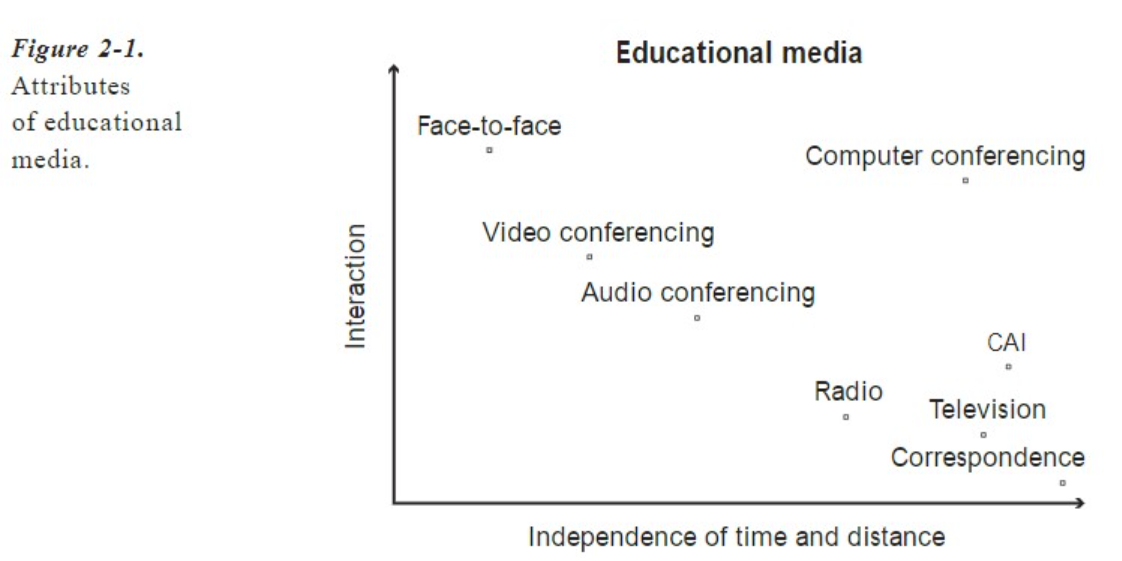
The Web affords interaction in many modalities. In Figure 2-1, we see the common forms of media used in distance education charted against their capacity to support independence (of time and place) and their capacity to support interaction. It can be seen that, generally, the higher and richer the form of communication, themore restrictions it places on independence.
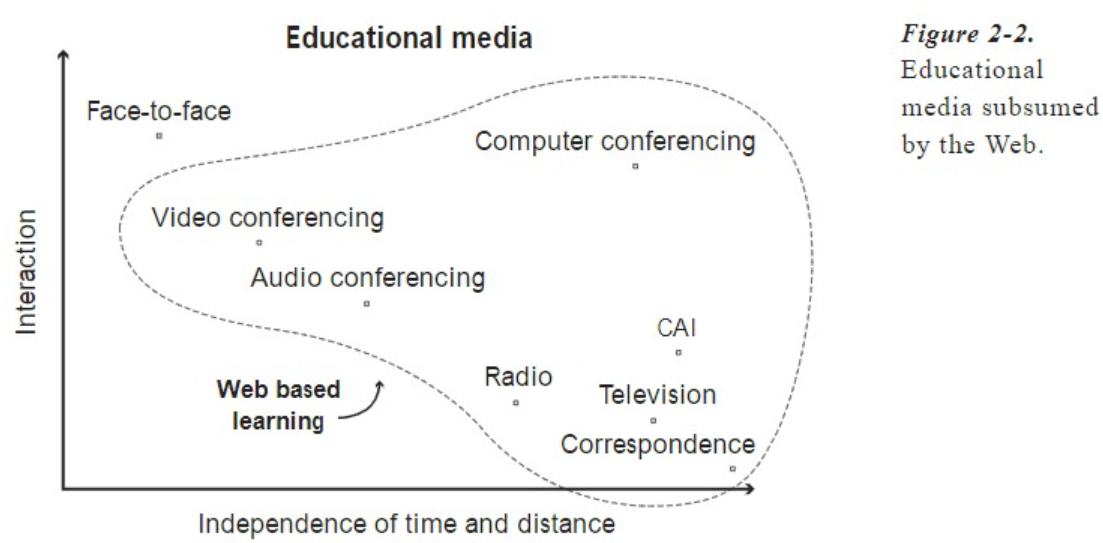
Figure 2-2 shows the capability of the Web to support these modalities. As can be seen, all forms of mediated educational interaction are now supported, assuming one adds the use of the Web to enhance classroom-based education. Thus, the capacity for the Web to support online learning in general is usually too large a domain for meaningful discussion until one specifies the particular modality of interaction in use.
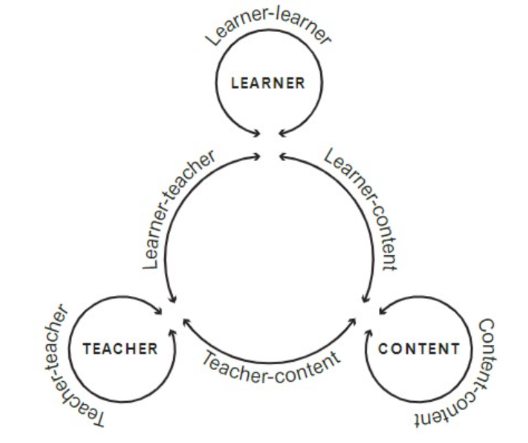
Interaction can also be delineated in terms of the actors participating in it. Michael Moore first discussed the three most common forms of interaction in distance education: student-student, student-teacher, and student-content (Moore, 1989). This list was expanded by Anderson and Garrison (1998) to include teacher-teacher, teacher-content, and content-content interaction. I have been developing an equivalency theorem describing the capacity to substitute one form of interaction for another, based on cost and accessibility factors (Anderson, 2002; Anderson, 2003).
Figure 2-3 illustrates these six types of educational interaction, and each is described briefly below.
-
Student-student Interaction
Traditionally, student-student interaction has been downplayed as a requirement of distance education as a result of constraints on the availability of technology and an earlier bias among distance-education theorists toward individualized learning (Holmberg,1989). Modern constructivist theorists stress the value of peer-to-peer interaction in investigating and developing multiple perspectives. Work on collaborative learning illustrates potential gains in cognitive learning tasks, as well as increases in completion rates and the acquisition of critical social skills in education (Slavin,1995). Work by Damon (1984) and others related to peer tutoring illustrates the benefits to both the tutor and the tutee that can result from a variety of forms of “reciprocal” teaching. Finally, peer interaction is critical to the development of communities of learning (Wenger, McDermott,&Snyder, 2002) that allow learners to develop interpersonal skills, and to investigate tacit knowledge shared by community members as well as a formal curriculum of studies.
-
Student-teacher Interaction
Student-teacher interaction is supported in online learning in a large number of varieties and formats that include asynchronous and synchronous communication using text, audio, and video. The facility of such communications leads many new teachers to be overwhelmed by the quantity of student communications and by the rise in students’ expectations for immediate responses.
-
Student-content Interaction
Student-content interaction has always been a major component of formal education, even in the form of library study or the reading of textbooks in face-to-face instruction. The Web supports these more passive forms of student-content interaction, and also provides a host of new opportunities, including immersion in microenvironments, exercises in virtual labs, online computer-assisted tutorials, and the development of interactive content that responds to student behavior and attributes (often referred to as“student models”). Eklund (1995) lists some potential advantages of such approaches, noting that they allow instructors to:
•provide an on line or intelligent help facility, if a user is modeled and their path is traced through the information space;
•use an adaptive interface based on several stereotypical user classes to modify the environment to suit individual users; and
•provide adaptive advice, and model the learner’s use of the environment (including navigational use, answers to questions, and help requested) to make intelligent suggestions about a preferred individualized path through the knowledge base.
To these advantages must be added the capacity for immediate feedback, not only for formal learning guidance, but also for just-in-time learning assistance through job aids and other performance support tools.
-
Teacher-teacher Interaction
Teacher-teacher interaction creates the opportunity for professional development and support that sustains teachers through communities of like-minded colleagues. These interactions also encourage teachers to take advantage of knowledge growth and discovery in their own subject and within the scholarly community of teachers.
-
Teacher-content Interaction
Teacher-content interaction focuses on the creation of content and learning activities by teachers. It allows teachers continuously to monitor and update the content resources and activities that they create for student learning.
-
Content-content Interaction
Content-content interaction is a newly developing mode of educational interaction in which content is programmed to interact with other automated information sources, so as to refresh itself constantly, and to acquire new capabilities. For example, a weather tutorial might take its data from current meteorological servers, creating a learning context that is up-to-date and relevant to the learner’s context. Content-content interaction is also necessary to provide a means of asserting control of rights and facilitating tracking of the use of content by diverse groups of learners and teachers.
-
A Model of E-learning
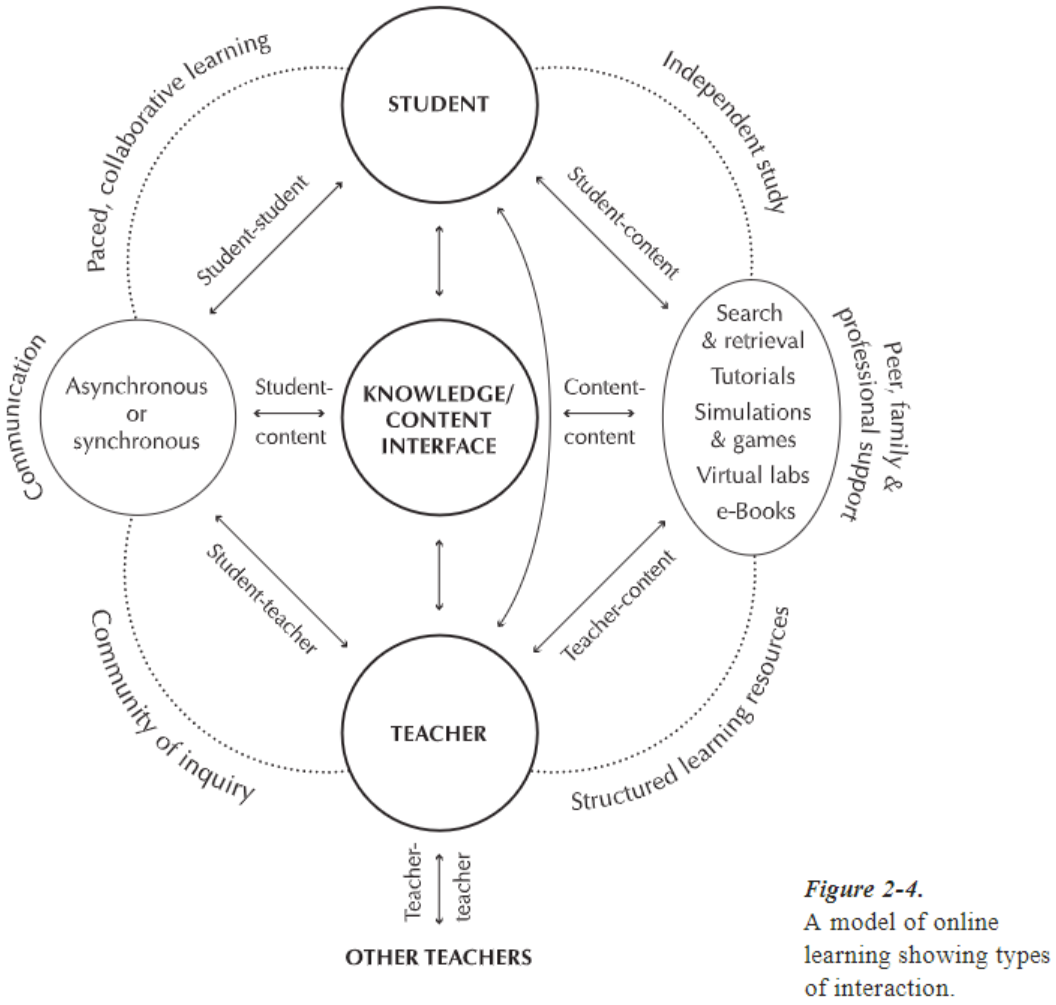
A first step in theory building often consists of the construction of a model in which the major variables are displayed and the relationships among the variables are schematized. Figure 2-4 provides a model that illustrates the two major modes of online learning. The model illustrates the two major human actors, learners and teachers, and their interactions with each other and with content Learners can of course interact directly with content that they find in multiple formats, and especially on the Web; however, many choose to have their learning sequenced, directed, and evaluated with the assistance of a teacher. This interaction can take place within a community of inquiry, using a variety of Net-based synchronous and asynchronous activities (video, audio, computer conferencing, chats, or virtual world interaction). These environments are particularly rich, and allow for the learning of social skills, the collaborative learning of content, and the development of personal relationships among participants. However, the community binds learners in time, forcing regular sessions or at least group-paced learning. Community models are also, generally, more expensive, as they suffer from an inability to scale to large numbers of learners. The second model of learning (on the right) illustrates the structured learning tools associated with independent learning. Common tools used in this mode include computer-assisted tutorials, drills, and simulations. Virtual labs, in which students complete simulations of lab experiments, and sophisticated search and retrieval tools are also becoming common instruments for individual learning. Printed texts (now often distributed and read online) have long been used to convey teacher interpretations and insights in independent study. However, it should also be emphasized that, although engaged in independent study, the student is not alone. Often colleagues in the work place, peers located locally (or distributed, perhaps across the Net), and family members have been shown to be significant sources of support and assistance to independent study learners (Potter, 1998).
Using the online model, then, requires that teachers and designers make crucial decisions at various points. A key decision factor is based on the nature of the learning that is prescribed. Marc Prensky (2000) argues that different learning outcomes are best learned through particular types of learning activities. Prensky asks not, “How do students learn?” but more specifically, “How do they learn what?”Prensky (2000, p. 156) postulates that, in general, we all learn:
•behaviors through imitation, feedback, and practice;
•creativity through playing;
•facts through association, drill, memory, and questions;
•judgment through reviewing cases, asking questions, making choices, and receiving feedback and coaching;
•language through imitation, practice, and immersion;
•observation through viewing examples and receiving feedback;
•procedures through imitation and practice;
•processes through system analysis, deconstruction, and practice;
•systems through discovering principles and undertaking graduated tasks;
•reasoning through puzzles, problems, and examples;
•skills (physical or mental) through imitation, feedback, continuous practice, and increasing challenge;
•speeches or performance roles through memorization, practice, and coaching;
•theories through logic, explanation, and questioning.
Prensky also argues that there are forms and styles of games that can be used, online or offline, to facilitate the learning of each of these skills. I would argue that each of these activities can be accomplished through e-learning, using some combination of online community activities and computer-supported independent-study activities. By tracing the interactions expected and provided for learners through the model, one can plan for and ensure that an appropriate mix of student, teacher, and content interaction is designed for each learning outcome.
附:讨论学习引导单
-
小组讨论:分析在线学习平台的交互设计与实现方式
活动类型:讨论交流活动名称:小组讨论:分析在线学习平台的交互设计与实现方式活动描述:1.选择一个你熟悉的在线学习平台。请你结合所读文献,并在智能体辅助下,分析该平台中至少三种交互类型是如何被设计和实现的?以及这些设计或实现方式存在哪些优点与不足? 2.以学术伙伴身份,为同学的帖子送上建设性反馈。 PS:每个小组分析的平台尽可能不重复。-
讨论交流活动说明
参考资源:
(论文类)1.在线开放课程中的交互设计及其应用现状分析_杨九民 2.我国在线教育现状考察与发展趋向研究——基于网易公开课等16个在线教育平台的分析_杨晓宏
3.师生交互对大学生的影响研究——基于Moodle平台的个案调查_李娟 4.国内主流MOOC平台交互功能对比研究——基于教学交互层次塔理论_陈娟菲
(平台类):包括但不限于
Coursera:https://www.coursera.org/
中国大学MOOC:https://www.icourse163.org/
国家高等教育智慧教育平台:https://higher.smartedu.cn/
学堂在线:https://www.xuetangx.com/
UMU:https://www.umu.cn/product/enterprise
Udacity:https://www.udacity.com/school/artificial-intelligence?ref=openi.cn
Khan Academy:https://pt.khanacademy.org/
网易云课堂:https://study.163.com/
-
绘制本主题阅读的概念图
活动类型:作业提交活动名称:绘制本主题阅读的概念图活动描述:1.在智能体协助下,小组协作绘制1张涵盖本节课所有知识和拓展知识的概念图(在知识节点旁边标注来源) 2.绘制概念图要逻辑清晰、结构严谨 3.完成后导出以PDF形式上传至讨论区(备注好组别和组员)-
同伴互评概念图
-
拓展学习资源及作品策展
Tips:如果想了解更多关于某个主题的文献可以通过 智能体(https://www.coze.cn/s/E7-IUPuAgiA/) 搜索
【例如:请检索有关“XX(某个主题,例如探究社区理论)”的国内外文献,并梳理该理论/概念/学者的学术发展史及其核心观点,并提供文献原文,确保文献真实可靠。】
拓展学习资源:
1.互动/交互(Interaction)
远程教育中三种互动教学方法的元分析_Bernard 远程教学交互研究的新视角_结构主义_王志军
在线开放课程中的交互设计及其应用现状分析_杨九民 在线同步教学中交互的设计与实施_穆肃
2.安德森(Anderson)的等效交互定理(Interaction Equivalency Theorem)
等效交互定理(Interaction Equivalency Theorem)_Anderson 重新找到平衡点:关于互动的更新理论依据_ Anderson
开放教育资源OER、大规模开放在线课程MOOCs与非正式学习时代的互动等效性_Miyazoe & Anderson
基于Anderson理论设计的在线教育在促进护理学生实践学习体验中的应用:一项现象学研究_Bayram
再论混合权利_一种最新的有关交互的理论定理_特里·安德森 特里·安德森远程教育理论与实践研究_郑炎顺
等效交互原理_宫副照美 开放教育资源、大规模开放网络课程(MOOCs)和非正式学习时代中的等效交互_宫添辉美
3.教学交互层次塔[Instructional Interaction Hierarchy Tower,或hierarchical model for instructional interaction (HMII)]
适用于“学习型组织”和“学习型社会”的个体学习对话框架_Laurilard 1999 联通主义学习情境中的交互与认知参与框架_Wang
远程学习的教学交互模型和教学交互层次塔_陈丽 三代远程学习中的教学交互原理_陈丽
4.探究社区理论(Community of Inquiry, CoI)
通过“探究社区”框架考察开放在线课程中学习者的互动_Saadatmand 虚拟学习社区的知识建构分析框架_甘永成
探究社区理论框架研究二十年_回顾与展望_万力勇 虚拟学习社区知识建构和集体智慧发展的学习框架_甘永成
5.交互/互动的新发展
基于交互主题的在线学习知识创造研究_吴磊 群体知识图谱建构对教师在线学习与交互的影响研究_马宁
在线学习的核心要义与转型路向_艾兴 专递课堂多向互动教学如何促进乡村学校教育质量提升_穆肃
小组讨论作品与概念图策展:
1.第一讲小组概念图:第五组(杨馥蔚 张新悦 刘永青 黄子涵)SWU黄子涵
2.第一讲小组概念图:第三组 兰杨 聂鑫毅 田兴文 赵勇桂 肖哲宇SWU兰杨
3.第二讲小组概念图:第五组:杨馥蔚 张新悦 刘永青 黄子涵SWU黄子涵
4.第二讲小组概念图:概念图-第二组 何雨轩 朱琪琪 李金香 张笑菡swu何雨轩
5.第二讲小组讨论活动:第二组 何雨轩 朱琪琪 李金香 张笑菡
6.第二讲小组讨论活动:第七组 钟林容 许邯郸 邹何林
7.第二讲小组讨论活动:第一组 郭韫 陈佳凝 骆开燕 张晨
-
群智汇聚,新的思考
活动类型:讨论交流活动名称:群智汇聚,新的思考活动描述:结合所学,讲讲自己对 在线学习交互 新的认识(包括 新思想、新观点、新技术以及新方法等) 每个同学至少提出一点,其他同学可补充,解释或者完善,至少回复两位同学(以建立观点的连接) PS:有理有据,关键资料可附文献来源或标注知识来源(如智能体,自我思考或群体启发等) -
- 标签:
-
加入的知识群:
.jpg)

学习元评论 (0条)
聪明如你,不妨在这 发表你的看法与心得 ~