


-
第三讲: 在线学习与网络支持
普通类 -
- 支持
- 批判
- 提问
- 解释
- 补充
- 删除
-
-
智能体V3.0版链接
新的学习伙伴:https://www.coze.cn/s/E7-IUPuAgiA/
温馨提示:我可以通过问题解答和启发式提问引导深入理解学术文献,助力高效学习与协作学习(包括文献查找与翻译、知识库调用、概念图绘制引导等)。
-
Affordances of the Net
Effective educational theory must address the affordances and the limitations of the context for which it is designed (Norman, 1999). The World Wide Web is a multifaceted technology that provides a large set of communication and information management tools that can be harnessed for effective education provision. It also suffers from a set of constraints that are briefly outlined in this section.
Online learning, as a subset of all distance education, has always been concerned with providing access to educational experience that is at least more flexible in time and in space than campusbased education. Access to the Web is now nearly ubiquitous in developed countries. The Wall Street Journal of February 4, 2002, reported that 54% of U.S. adults use the Web on a regular basis, and 90% of 15-17 years olds are regular Web users. This high percentage of users would probably include well over 90% of those citizens interested in taking a formal education course. Access to the Web is primarily through home or workplace machines, but placements in public libraries and Internet cafes and connections through personal wireless devices are such that access poses no problems for the vast majority of citizens of developed countries. I have also been surprised by the availability of access in developing countries, as exemplified by free use of the Net in McDonald’s restaurants in Sao Paulo, Brazil, and the numerous Internet cafés, in most Chinese cities. Access is still problematic for those with a variety of physical handicaps; however, in comparison with books or video media, the Web provides much greater quality and quantity of access to nearly all citizens, with or without physical disabilities.
Access is increasing, not only to technology, but also to an evergrowing body of content. The number of scholarly journals (see http://www.e-journals.org), educational objects (see http://www. merlot.org/Home.po), educational discussion lists (see http://www .kovacs.com/directory), courses (see http://courses.telecampus.edu/ subjects/index.cfm), and general references to millions of pages of commercial, educational, and cultural content (see http://www .google.com) is large and increasing at an exponential rate. Thus, online learning theory must acknowledge the change from an era of shortage and restrictions in content to one in which content resources are so large that filtering and reducing choice is as important as providing sufficient content.
The Web is quickly changing from a context defined by textbased content and interactions to one in which all forms of media are supported. Much of the early work on the instructional use of the Internet (Harasim, 1989; Feenberg, 1989) assumed that asynchronous text-based interaction defined the medium. Techniques were developed to maximize interaction using this relatively lean medium. We are now entering an era where streaming video, video and audio conferencing, and virtual worlds are readily available for educational use. Thus, online learning theory needs to help educators to decide which of the many technological options is best suited for their application.
The Web’s in-built capacity for hyperlinking has been compared to the way in which human knowledge is stored in mental schema and to the subsequent development of mental structures (Jonassen, 1992). Further, the capacity for students to create their own learning paths through content that is formatted with hypertext links is congruent with constructivist instructional design theory that stresses individual discovery and construction of knowledge (Jonassen, 1991).
Finally, the growing ease with which content can be updated and revised (both manually and through use of autonomous agent technology) is making online learning content much more responsive and potentially more current than content developed for other media. The explosion of Web “blogs” (Notess, 2002) and userfriendly course-content management systems, built into Web delivery systems such as WebCT or Blackboard, is creating an environment in which teachers and learners can very create and update their course content without the aid of programmers or designers. Naturally, this ease of creation and revision leads to potential for error and lessthan-professional-standard output; however, educators who are anxious to retain control of their educational content and context welcome this openness and freedom.
Education is not only about access to content. However, the greatest affordance of the Web for educational use is the profound and multifaceted increase in communication and interaction capability that it provides. The next section discusses this affordance in greater detail.
-
Online Learning and the Semantic Web
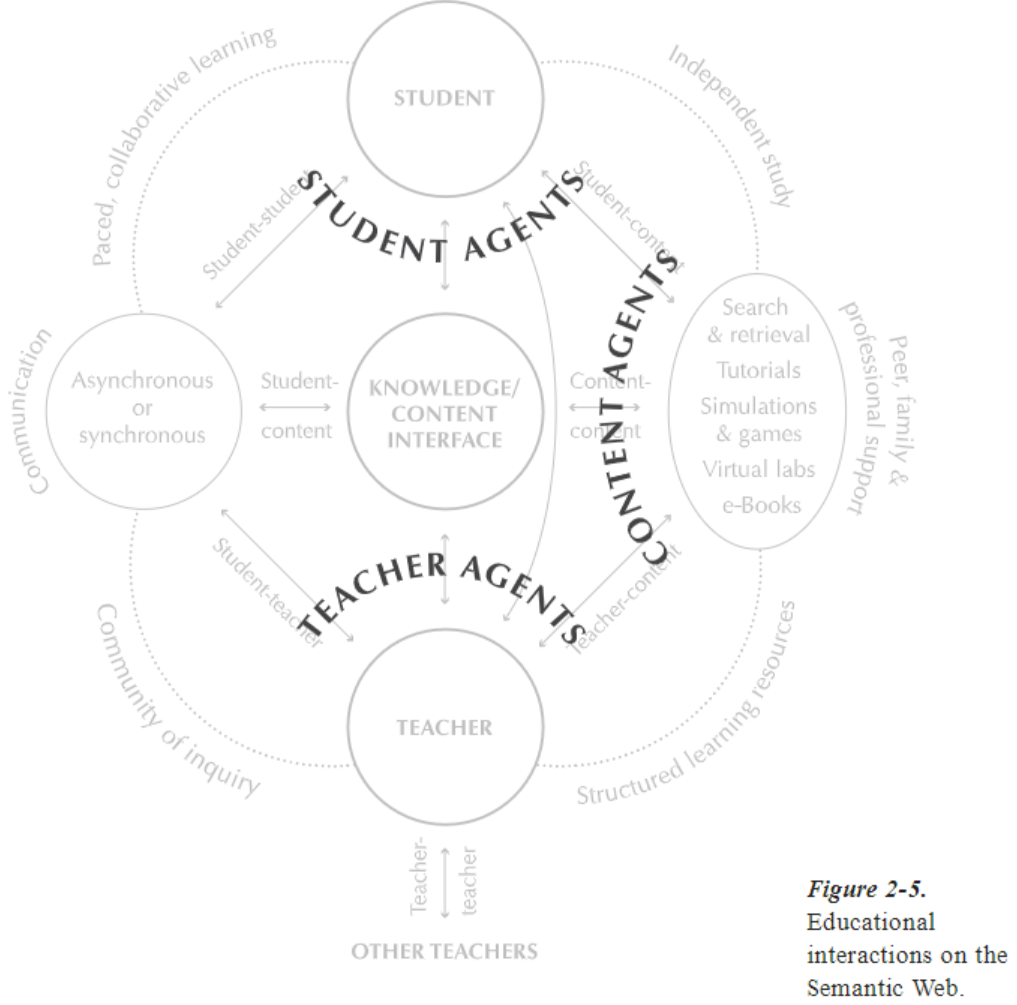
We are entering an era in which the Web is changing from a medium to display content, to one in which content is endowed with semantic meaning (Berners-Lee, 1999). If the format and structure of content is described in formalized and machine-readable languages, then it can be searched and acted upon, not only by humans but also by computer programs commonly known as autonomous agents. This new capacity has been most prominently championed by the original designer of the Web, Tim Berners-Lee, and is named by him the “Semantic Web.”
The Semantic Web will be populated by a variety of autonomous agents—small computer programs designed to navigate the Web, searching for particular information and then acting on that information in support of their assigned task. In education, student agents will be used for intelligent searching of relevant content, and as secretaries for booking and arranging for collaborative meetings, for reminding students of deadlines, and for negotiating with the agents of other students for assistance, collaboration, or socialization. Teacher agents will be used to provide remedial tuition, and to assist with record keeping, with monitoring student progress, and even with marking and responding to student communications. Content itself can be augmented with agents that control rights to its use, automatically update it, and track the means by which the content is used by students (Thaiupathump,Bourne,&Campbell, 1999; Shaw, Johnson,&Ganeshan, 1999).
The Semantic Web also supports the reuse and adaptation of content by supporting the construction, distribution, and dissemination of digitized content that is formatted and formally described (Wiley, 2000; Downes, 2000). The recent emergence of educational modeling languages (Koper, 2001) allows educators to describe, in a language accessible on the Web, not only the content but also the activities and context or environment of learning experiences. Together these capabilities afforded by the Semantic Web allow us to envision an e-learning environment that is rich with student-student, student-content, and student-teacher interactions that are affordable, reusable, and facilitated by active agents (see Figure 2-5, below).
-
讨论交流:网络技术与学习支持
活动类型:讨论交流活动名称:讨论交流:网络技术与学习支持活动描述:假设你是一名教育技术专业的大二学生,正在修读《教育技术新发展》这门采用混合学习模式的课程。现在平台界面除过学习内容和学习活动显示外,你会选择哪一种学习网络辅助学习(社会网络、知识网络与社会知识网络)?为什么? 在智能体辅助下,结合本节内容论述,包括分析其对学习的支持与你的需求。-
讨论交流活动说明:思考社会网络、知识网络与社会知识网络的技术支持以及所能提供的学习服务
围绕讨论主题,可从以下讨论提纲中选择你感兴趣的问题切入点,在讨论区开展多轮讨论。或:设计1个“高质量问题”,并发起讨论帖,与同伴开展多轮讨论:(每位学生需至少参与2个不同问题帖的讨论)
讨论提纲:
1.将XX网络中的某个核心元素替代?以及替代后会怎样? 2.XX网络能与什么其他元素结合?结合后会产生什么新形态?对学习有何影响?3.如何调整XX网络以更好地适应混合学习场景? 4.修改、放大或缩小XX网络的某个特征,可能会对学习产生哪些积极与消极影响?5.XX网络除了支持学习,还起到了哪些作用? 6.如果去掉XX网络的某个关键属性,会怎样? 7.如何重组要素或反向思考其运作逻辑?
PS:在讨论过程中,可通过与智能体展开对话(https://www.coze.cn/s/E7-IUPuAgiA/),协助思考,或与同伴开展观点辩论。
【提示词指南:第三讲 讨论活动的提示词指南(仅供参考,不仅限于此)】
高质量问题标准:1.能够引发多种观点;2.需要分析推理,而非简单查找;3.可以持续引发深入讨论;4.结合在线学习情境。
讨论内容需体现以下至少1种行为:解释(对观点进行阐述或补充)、质疑(提出不同观点或挑战)、整合(综合他人观点形成新理解)。
社会网络学习场景:
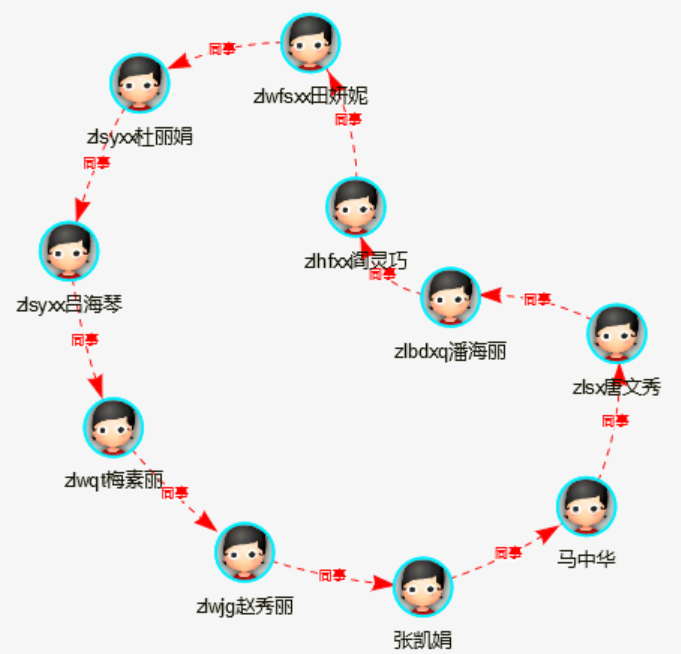
在学习的过程中,你可以查看基于某个主题的全体参与者(头像)
你可以点击每一个学习者头像,进入其学习空间查看她的简历,学习轨迹与路径,学习爱好以及好友圈子;
你可以通过点击用户头像的方式,和她/他建立社交关系,可以发送消息,邮件,可以微信或者QQ。
知识网络学习场景:
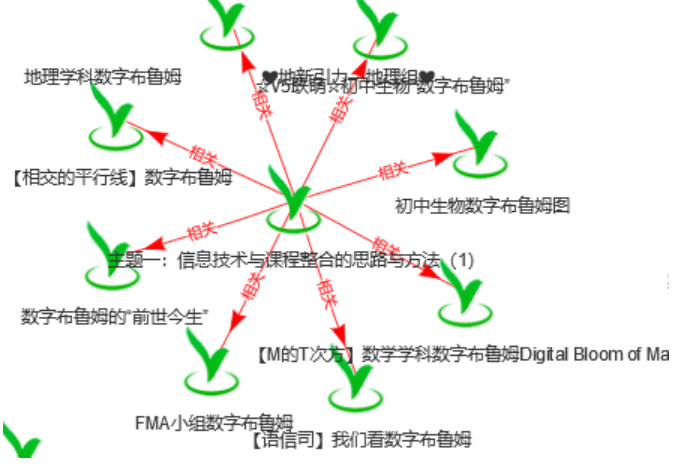
课前可以给学生展示基于某一个主题的全部知识框架;
课中可以帮助学习者进行知识的梳理与观点的联结,学习者可以在学习的过程中能够创建某一个知识节点,也可以通过发表评论等方式为共享知识库增加新的知识
课后可以通过点击某一个知识节点进行复习,还可以查看与此主题相关的其他知识。
PS:只看见知识,看不见人,即学习过程中学习者通过发表评论,增加知识来表示自己的社区存在。
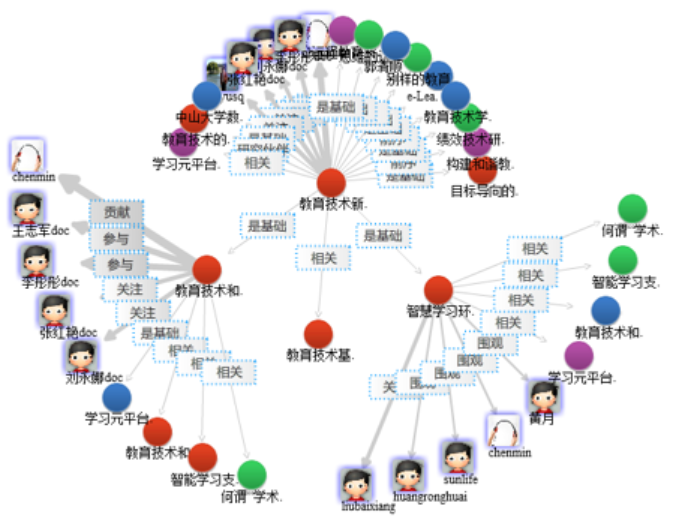
社会知识网络:
-
Toward a Theory of Online Learning
The Web offers a host of very powerful affordances to educators. Existing and older education provisions have been defined by the techniques and tools designed to overcome the limitations and exploit the capacities of earlier media. For example, the earliest universities were constructed around medieval libraries that afforded access to rare hand-written books and manuscripts. Early forms of distance education were constructed using text and the delayed forms of asynchronous communications afforded by mail services. Campus-based education systems are constructed around physical buildings that afford meeting and lecture spaces for teachers and groups of students. The Web provides nearly ubiquitous access to quantities of content that are many orders of magnitude larger than those provided in any other medium.
From our earlier discussion, we see that the Web affords a vast potential for education delivery that generally subsumes almost all the modes and means of education delivery previously used, with perhaps the exception of the rich face-to-face interaction of the classroom. We have also seen that the most critical component of formal education consists of interaction between and among multiple actors, humans and agents included.
Thus, I conclude this chapter with an overview of a theory of online learning interaction that suggests that the various forms of student interaction can be substituted for each other, depending on costs, content, learning objectives, convenience, technology, and available time. The substitutions do not result in decreases in the quality of the learning that results. More formally. Sufficient levels of deep and meaningful learning can be developed, as long as one of the three forms of interaction (student-teacher; student-student; student-content) is at very high levels. The other two may be offered at minimal levels or even eliminated without degrading the educational experience. (Anderson, 2002).
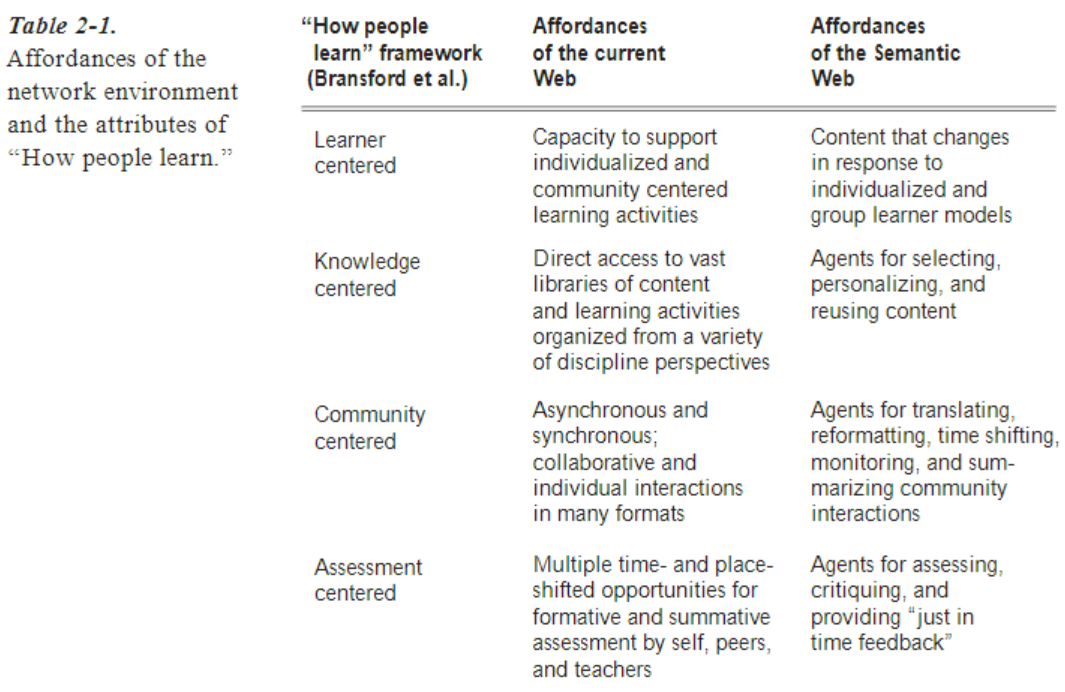
The challenge for teachers and course developers working in an online learning context is to construct a learning environment that is simultaneously learning centered, content centered, community centered, and assessment centered. There is no single, right medium of online learning, nor a formulaic specification that dictates the kind of interaction most conducive to learning in all domains with all learners. Rather, teachers must learn to develop their skills so that they can respond to student and curriculum needs by developing a set of online learning activities that are adaptable to diverse student needs. Table 2-1 illustrates how the affordances of these emerging technologies can be directed so as to create the environment that is most supportive of “how people learn.”
-
Conclusion
This discussion highlights the wide and diverse forms of teaching and learning that can be supported on the Web today, and the realization that the educational Semantic Web will further enhance the possibilities and affordances of the Web, making it premature to define a particular theory of online learning. However, we can expect that online learning, like all forms of quality learning, will be knowledge, community, assessment, and learner centered. Online learning will enhance the critical function of interaction in education in multiple formats and styles among all the participants.
These interactions will be supported by autonomous agents working on behalf of all participants. The task of the online course designer and teacher is to choose, adapt, and perfect (through feedback, assessment, and reflection) educational activities that maximize the affordances of the Web. In doing so, they create learning-, knowledge-, assessment-, and community-centered educational experiences that result in high levels of learning by all participants. Integration of the new tools and affordances of the Semantic Web further enhances the quality, accessibility, andd affordability of online learning experiences.
Our challenge as theory builders and online practitioners is to delineate which modes, methods, activities, and actors are most effective, in terms of cost and learning, in creating and distributing quality e-learning programs. The creation of a model is often the first step toward the development of a theory. The model presented illustrates most of the key variables that interact to create online educational experiences and contexts. The next step is to theorize and measure the direction and magnitude of the effect of each of these variables on relevant outcome variables, including learning, cost, completion, and satisfaction. The models presented in this chapter and other chapters in this book do not yet constitute a theory of online learning, but it is hoped that they will help us to deepen our understanding of this complex educational context and lead us to hypotheses, predictions, and most importantly improvements in our professional practice. It is hoped that the model and discussion in this and other chapters in this book lead us toward a theory of online learning.
-
绘制本主题阅读的概念图
活动类型:作业提交活动名称:绘制本主题阅读的概念图活动描述:1.在智能体协助下,小组协作绘制1张涵盖本节课所有知识和拓展知识的概念图(在知识节点旁边标注来源,如智能体,自我思考或群体启发等) 2.绘制概念图要逻辑清晰、结构严谨 3.完成后导出以PDF形式上传至讨论区(备注好组别和组员)-
拓展资源
Tips:如果想了解更多关于某个主题的文献可以通过 智能体(https://www.coze.cn/s/E7-IUPuAgiA/) 搜索
【例如:请检索有关“XX(某个主题,例如认知网络)”的国内外文献,并梳理该理论/概念/学者的学术发展史及其核心观点,并提供文献原文,确保文献真实可靠。】
1.学习元平台:基于学习元的双螺旋深度学习模型_余胜泉 学习元平台的语义技术架构及其应用_杨现民
2.社会网络分析:虚拟学习社区的社会网络分析_王陆 虚拟学习社区社会网络中的凝聚子群_王陆
网络环境下群体互动学习分析的应用研究——基于社会网络分析的视角_刘三女牙
3.认知网络分析:认知网络分析法及其应用案例分析_王志军 认知网络分析法_STEM教育中的学习评价新思路_吴忭
4.社会认知网络分析:探析深度学习表征的一种新方法:社会认知网络特征(SENS)_冷静 面向多维关联的社会认知网络分析——协作学习交互研究的新进展_马志强学习共同体演化动态及其参与者交互模式研究——数据驱动的社会认知网络分析_彭文辉 连接式建构:知识建构研究的新取向_万海鹏
-
群智汇聚,新的思考
活动类型:讨论交流活动名称:群智汇聚,新的思考活动描述:请结合所学,讲讲自己对在线学习新的认识(包括 新思想、新观点、新技术以及新方法等) 每个同学至少提出一点,其他同学可补充,解释或者完善 PS:有理有据,关键资料可附文献来源或标注知识来源(如智能体,自我思考或群体启发等)-
评价数字制品
-
-
- 标签:
-
加入的知识群:
.jpg)

学习元评论 (0条)
聪明如你,不妨在这 发表你的看法与心得 ~