


-
第五讲:在线学习社区及设计
普通类 -
- 支持
- 批判
- 提问
- 解释
- 补充
- 删除
-
-
Introduction
One of the most widely used frameworks for building communities online is the Community of Inquiry (CoI) theoretical framework developed by Garrison, Anderson, and Archer (2000). Applying the CoI framework as a lens, the purpose of this article is to provide a collection of CoI instructional strategies based in cognitive presence, social presence, and teaching presence (Garrison, Anderson, & Archer, 2000), for practitioners (instructors, online course developers, instructional designers) to use in online courses. This collection of CoI instructional strategies is built using Sorensen and Baylen’s (2009) seven principles of good practice. Garrison and Arbaugh (2007) indicated the need for practical strategies and guidelines for how to facilitate presence from a real-world pedagogical perspective as a future area for CoI research. This article hopes to fill this void.
-
Community and CoI Framework
History of CoI Grounded in John Dewey’s (1938) view of practical inquiry, Garrison et al. first introduced the Community of Inquiry (CoI framework) in 2000 (as cited in Swan & Ice, 2010). With inquiry and community at the core of his philosophy, Dewey believed individual development was dependent upon community (Swan, Garrison, & Richardson, 2009). “Community,” a word used copiously in educational research, is often used to refer to the cognitive or emotional connections established between physically separated learners. A broad construct of community has been defined by McMillan and Chavis (1986) as “a feeling that members have of belonging, a feeling that members matter to one another and to the group, and a shared faith that members’ needs will be met through their commitment to be together” (p. 9). Wang, Laffey, and Poole (2001) argue that community can result from shared knowledge among online learners, and this online community is especially important as Rovai (2000) stated, “strong feelings of community increase the flow of information, the availability of support, commitment to group goals, cooperation among members, and satisfaction with group efforts” (p. 286).
-
CoI in Online Learning Environments
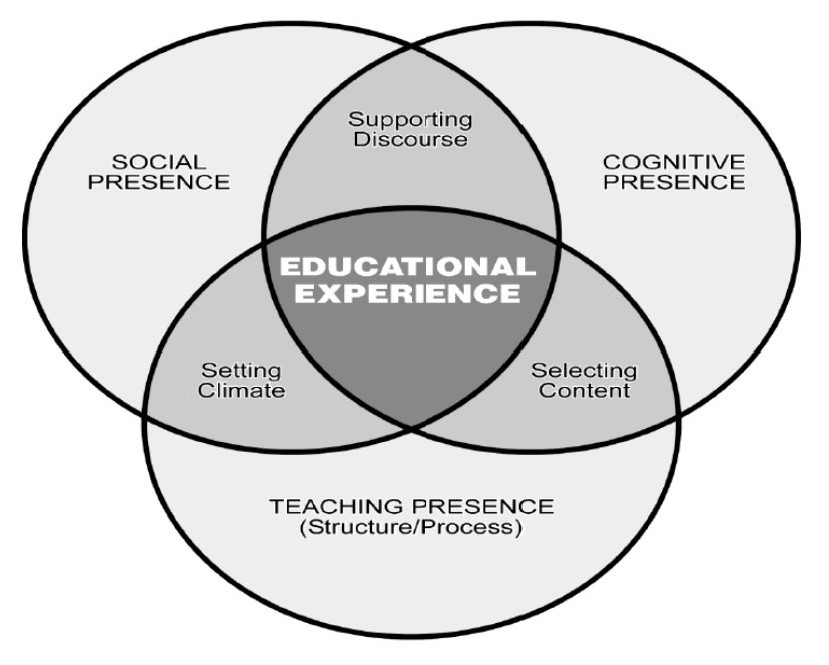
The literature specifically advocates that within online environments, interaction between learners is of great importance to student success (Akyol & Garrison, 2008; Arbaugh, 2008; Richardson, Maeda, Lv, & Caskurlu, 2017). The CoI framework that highlights three core elements –cognitive presence, social presence, and teaching presence-is used to create a meaningful educational experience (Garrison et al., 2000). These presences are interdependent as depicted in Figure 1. The CoI framework assumes that effective online learning, particularly higher order learning, is dependent on the development of a community (Swan et al., 2009). Since its publication in 2000, researchers have suggested additions to the original framework in terms of presences, dimensions, and influences (Kozan & Caskurlu, 2018; Peacock & Cowan, 2016). This article will focus on three original presences as defined by Garrison et al. (2000). For additions to the CoI framework, refer to Kozan and Caskurlu (2018) and Peacock and Cowan (2016). The three presences of the CoI framerwork as discussed in this article are multidimensional, but in order to understand how they work collectively we must examine them individuall.
-
Framework
-
Cognitive Presence
Cognitive presence, the ability to construct and confirm meaning through sustained reflection (Anderson, Rourke, Garrison, & Archer, 2001), is demonstrated in the Practical Inquiry Model (PIM) created by Garrison et al. (2000) and depicted in Figure 2. The PIM includes four phases: (1) a triggering event, where a problem is identified for further inquiry; (2) exploration, where an individual explores the issue; (3) integration, where learners concept meaning from ideas formed in the exploration phase; and (4) resolution, where students can apply the new skills and knowledge learned from the previous phases into real-world application(s) (Garrison et al., 2000). Reflection is a key aspect of the CoI framework and helps learners to increase their cognitive presence as Redmond (2014) states, “reflecting on learning content and outcomes relates to knowledge acquisition where learners identify their increased knowledge and skills in the subject area” (p. 50).
-
Social Presence
According to Lowenthal and Lowenthal (2010), “social presence is a theory that explains the ability of people to present themselves as ‘real people’ through a communication medium. Most studies on social presence focus on how students present themselves and/or are perceived as ‘real’ people online” (p. 1). Garrison et al. (2000) determined three categories of social presence indicators. These categories are: (1) emotional (affective) expression, where learners share personal expressions and values; (2) open communication, where learners develop aspects of mutual awareness and recognition; and (3) group cohesion, where learners build and sustain a sense of group commitment (Garrison et al., 2000). A study conducted by Richardson and Swan (2003) found that social presence positively affects student and instructor course satisfaction. During the study, a relationship between social presence and perceived learning was identified; students who perceived high social presence learned more than those who perceived low social presence (Richardson & Swan, 2003).
-
Teaching Presence
Garrison and colleagues describe teaching presence as the design, facilitation, and direction of cognitive and social processes to support learning (Garrison & Arbaugh, 2007; Garrison et al., 2000). Teaching presence has three components: (1) instructional design and organization (e.g., setting curriculum, designing methods, etc.); (2) facilitating discourse (e.g., setting course climate, acknowledging or reinforcing student contributions, etc.); and (3) direct instruction (e.g., summarizing the discussion, presenting content/questions, etc.; Anderson et al., 2001).
-
Practical inquiry model of Cognitive Presence
The analysis of cognitive presence in the CoI framework is guided by the Practical Inquiry Model first presented in Garrison et al. (1999). Based upon Dewey's (1933) conception of practical inquiry, the model describes critical thinking as "a holistic multi-phased process associated with a triggering event" (Garrison et al., 1999, p. 98):
The model presented here assumes an iterative and reciprocal relationship between the personal and shared worlds. That is, there is a synergy between reflection and communicative action. Critical thinking is the integration of deliberation and action. This reflects the dynamic relationship between personal meaning and shared understanding (i.e., knowledge). Purposeful thinking and acting are essential to the educational process. (Garrison et al., 1999, p. 98)
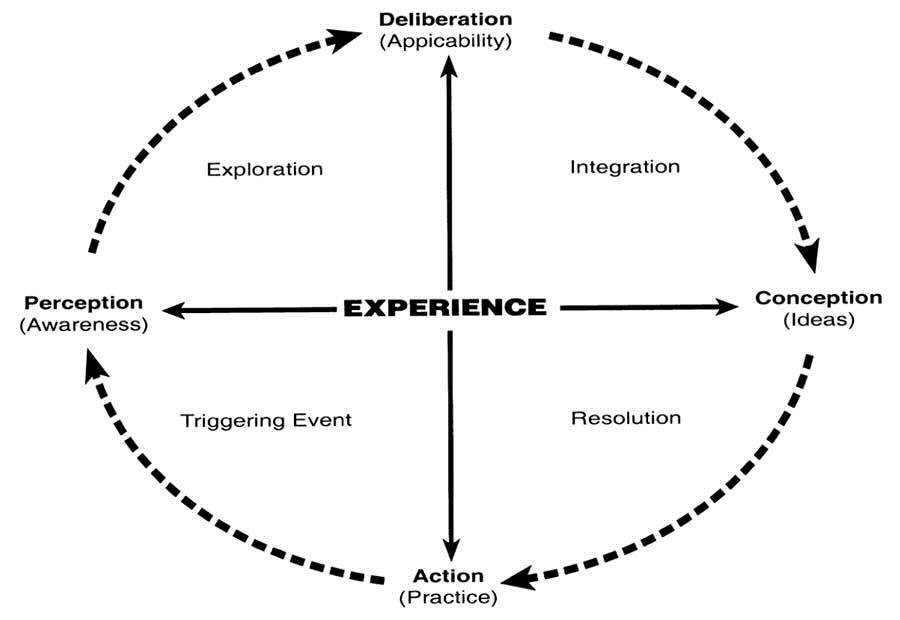
Practical Inquiry Model. Garrison, D. Randy, Anderson, T., & Archer, W. (1999). Critical Inquiry in a Text-Based Environment: Computer Conferencing in Higher Education. The Internet and Higher Education, 2(2-3), 87-105. https://www.doi.org/10.1016/S1096-7516(00)00016-6 ... The reflective phases of practical inquiry or critical thinking presented here are grounded in the pre- and post-reflective phases of the world of practice. The two axes that structure the model are action-deliberation and perception-conception. The first axis is reflection on practice. The second axis is the assimilation of information and the construction of meaning. Together, they constitute the shared and personal worlds. The quadrants reflect the logical or idealized sequence of practical inquiry (i.e., critical thinking) and correspond to the proposed categories of cognitive presence indicators.
The first category of cognitive presence represented in the model (lower left quadrant of [the figure above]) is a state of dissonance or feeling of unease resulting from an experience. This category is described as that of a triggering event or communication. The second category (upper left quadrant of [the figure above]) is that of exploration in a search for information, knowledge and alternatives that might help to make sense of the situation or problem. This category is described as that of searching for clarification and attempting to orient one's attention. The third category is integrating the information and knowledge into a coherent idea or concept. The description here is looking for insights and gaining some understanding of the acquired information and knowledge. The fourth category is the resolution of the issue or problem. This category is described as an application of an idea or hypothesis. The success of the application and whether the idea is confirmed will determine whether the process of inquiry continues. (Garrison et al., 1999, pp. 98-99).
-
ADAPTING THE MODEL FOR GENERATIVE AI
The Practical Inquiry Model has recently been adapted by Nasr et al. (2025) to support critical thinking in learning contexts incorporating generative AI. Recent studies, including Nasr et al. (2025), consider the extent to which generative AI tools such as ChatGPT can support or improve cognitive presence, with or without human guidance. Nasr et al.'s adapted model is shown below.
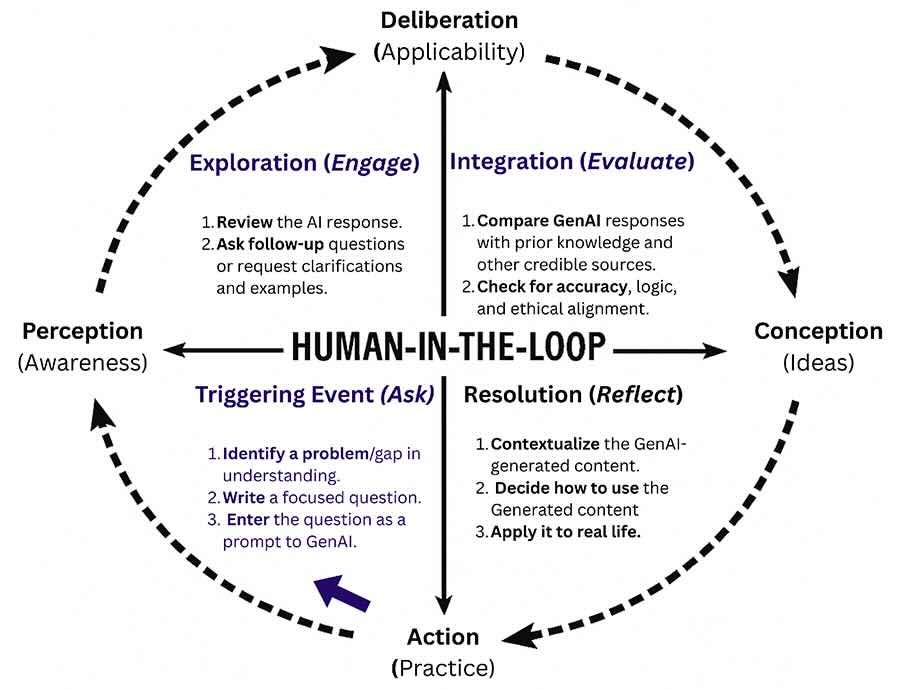
Adapting the Practical Inquiry framework to support critical thinking in a GenAI context. Nasr, N. R., Tu, C-H., Werner, J., Bauer, T., Yen, C-J., & Sujo-Montes, L. (2025). Exploring the Impact of Generative AI ChatGPT on Critical Thinking in Higher Education: Passive AI-Directed Use or Human–AI Supported Collaboration? Education Sciences, 15(9), 1198. https://doi.org/10.3390/educsci15091198 [CC-BY] -
小组协作分析:COI模型与在线学习设计
活动类型:作业提交活动名称:小组协作分析:COI模型与在线学习设计活动描述:1.结合学习体验、所读文献,以及智能体辅助下,选择如钉钉平台,腾讯会议,ZOOM,MOODLE,SAKAI,慕课等分析其如何体现教学存在,认知存在和社会存在的? 2.上述平台的COI的理念以及学理依据; 3.小组协作建构如何增强 在线教学中的三种存在?-
讨论交流活动说明
思路引导:填写并提交第五讲 在线学习平台“三大存在感”深度分析引导单,先通过用户移情图基于角色扮演记录使用体验;再结合记录的内容与查找相关文献,以系统分析平台“体现”或“缺失”的“三大存在感”;最后,针对平台“缺失”的“存在感”提出优化方法。(文档命名格式:“第X组-组长-组员”)
参考文献: 基于Claroline平台的网络课程学习社区的模型设计_陈卫东 教学存在、社会存在及认知存在关系研究——以基于MOOC的混合课程为例_白雪梅
Tips:在系统分析平台的“三大存在感”时,可通过智能体 V4.0(https://www.coze.cn/s/zlp3oxS7r7g/)查找相关文献协助分析。【例如,请帮忙查找有关“知识建构”的相关文章,分析······(XX工具的使用体验)在知识建构方面的优劣。】
(平台类):包括但不限于
Coursera:https://www.coursera.org/ 中国大学MOOC:https://www.icourse163.org/ 国家高等教育智慧教育平台:https://higher.smartedu.cn/
学堂在线:https://www.xuetangx.com/ UMU:https://www.umu.cn/product/enterprise edX:https://www.edx.org/
Udacity:https://www.udacity.com/school/artificial-intelligence?ref=openi.cn
Khan Academy:https://pt.khanacademy.org/ 网易云课堂:https://study.163.com/
-
绘制本主题阅读的概念图
活动类型:作业提交活动名称:绘制本主题阅读的概念图活动描述:1.在智能体协助下,小组协作绘制1张涵盖本节课所有知识和拓展知识的概念图(在知识节点旁边标注来源) 2.绘制概念图要逻辑清晰、结构严谨 3.完成后导出以PDF形式上传至讨论区(备注好组别和组员)-
群智汇聚,新的思考
活动类型:讨论交流活动名称:群智汇聚,新的思考活动描述:结合所学谈谈对 CoI和三大存在感 新认识(包括新思想/观点/技术/方法等) 1.每位同学至少发表1条帖子 2.评论至少3位其他同学的帖子 3.回复自己帖子下方的同伴//助教评论 PS:有理有据,附文献来源或标注知识来源(如智能体或其他AI,自我思考或群体启发等)-
群智汇聚讨论交流说明
讨论要求:1.每位同学至少发表1条帖子 2.评论至少3位其他同学的帖子(如质疑、补充等) 3.回复自己帖子下方的同伴/助教评论
可聚焦讨论主题,结合以下问题贴例加以思考,或对同伴的观点进行评价或质疑:(每位学生需至少回复3位同学的帖子)
思考点/问题贴例(但不限于此,可在此基础上提出新问题或新观点):
(1)AI 替代 探究社区 中的哪些“存在感”会削弱,还是增强学生学习?1.如果用通用大模型直接替代教材内容,学生在 CoI 中的“认知存在”(批判性探究)是否会被简化为“提示词工程”,从而丧失深度阅读的能力?2.AI 助教能否替代人类教师承担 CoI 中的“教学存在”(设计、促进、指导)?这种替代是否会导致教学温度的缺失?3.于在线讨论区,用 AI 生成的虚拟同伴替代真实同学发言,是会缓解“社交沉默”,还是制造虚假的社会存在感?
(2)将 AI 与 探究社区 “三大存在感”组合时,会削弱,还是增强学生学习?1.结合 AI 情感识别技术与在线论坛,系统能否根据学生的情绪波动自动调节 CoI 中的社会临场感(如推送鼓励或挑战)?2.将学科知识图谱与 AI 推理引擎组合,能否帮助学生跨越 CoI 中“信息汇集”到“知识整合”的认知鸿沟?3.结合元宇宙与生成式 AI,教师能否在虚拟空间中实现更强的“教学存在”,弥补远程教育的物理缺失?(3)如何根据学科差异,改造 AI 在 探究社区 中的介入方式?1.针对文科强调发散思维的特点,AI 能否改造讨论区的“社会存在”,通过故意引入对立观点来激化“意义协商”过程?2.在工程类探究社区中,AI 能否改造教材形态,从文本适应为“仿真环境”,以增强实践性的教学存在?3.在医学教育中,如何改造 AI 的反馈机制,使其在 CoI 中既能提供精准诊断支持,又不越界替代医生的临床判断(认知存在)?(4)调整教材结构或功能,对 学生的“三大存在感” 有何影响?1.若将教材从线性彻底改为 AI 驱动的网状结构,这是否会放大学生的认知负荷,导致其“认知存在”因迷失方向而瓦解?2.如果将 AI 的推荐逻辑完全透明化给学生,这会增强他们对教学存在的信任,还是破坏探究过程中的神秘感与惊喜感?3.利用 AI 将学习成果细化为微证书,这是否会将社区群体从“知识探究共同体”异化为“技能打卡绩效群”?(5)探究社区中产生的数据还能做什么?1.利用 AI 分析教师在探究社区中的教学存在行为(如提问质量、反馈时效),能否生成个性化的教师专业发展画像?2.将学生在探究社区中的困惑期数据(Pause Time)用于反向训练学习资源推荐算法,实现“越用越懂你”的动态进化?3.通过分析探究社区中社会存在的衰减(如发言减少、情绪消极),AI 能否提前激发学生的积极学习情绪或学习兴趣?(6)去掉什么,才能让探究社区回归本质?1.消除身份标识,让学生在探究社区中能够匿名发表观点,能否让学生更专注于观点本身(认知存在),而非发言者的社会地位?2.利用 AI 接管所有行政性、事务性的教学存在,能够促进教师回归到真正的“认知教练”角色?3.为了强制培养批判性思维,是否应在探究社区中消除 AI 给出的“标准答案”,仅保留社区论坛的开放性论证过程?(7)反过来想,学生定义一切?1.能否将学生与AI的关系定义为“学生是 AI 的训练师”,并让学生在探究社区中通过纠正 AI 的错误来深化其认知存在?2.能否打破专家评审,转由学生在探究社区中的实际学习成效来反向评判 AI 推荐算法的优劣?3.能否将教学存在的控制权从教师/AI 移交给学生群体,由 AI 辅助学生自学,实现完全去中心化的探究社区?PS:在讨论过程中,可通过与智能体 V4.0展开对话(https://www.coze.cn/s/zlp3oxS7r7g/),协助思考,或与同伴开展观点辩论。
高质量帖子标准:1.能够引发多种观点;2.需要分析推理,而非简单查找;3.可以持续引发深入讨论;4.结合在线学习情境。
讨论内容需体现以下至少1种行为:解释(对观点进行阐述或补充)、质疑(提出不同观点或挑战)、整合(综合他人观点形成新理解)。
-
拓展学习资源 & 数字制品策展
Tips:如果想了解更多关于某个主题的文献可以通过 智能体 V4.0(https://www.coze.cn/s/zlp3oxS7r7g/) 搜索
【例如:请检索有关“XX(某个主题,例如探究社区/教学存在感/认知存在感/社会存在感)”的国内外文献,并梳理该理论/概念/学者的学术发展史及其核心观点,并提供文献原文,确保文献真实可靠。】
CoI:The Community of Inquiry (The Community of Inquiry is a project of Athabasca University, Mount Royal University, KTH Royal Institute of Technology, and the Canadian Journal of Learning and Technology, as well as researchers and members of the CoI community.)
论文:“半衰期”_虚拟学习社区研究的新方法_白继芳 基于e-Learning平台的网络学习社区的评价方法应用研究_陈淑洁
极客、联结与建构_网络学习社区类型比较_叶韦明 在线学习社区中的知识隐藏行为及影响机制研究_翟雪松
第四讲小组数字制品策展(作品初步设想):
第四小组:王雯雯 胡晓筱 黄洁 陈银银(共生智慧学习空间) 第五组 刘永青、黄子涵、张新悦、杨馥蔚(数字孪生黄河学习空间设计)
第六组 程玉宁、胡淳洁、王晓 (智联·共生·无界——未来在线学习环境设计)
第五讲 小组协作分析:第四组 胡晓筱 -王雯雯、黄洁、陈银银swu陈银银 第五组 刘永青 张新悦 黄子涵 杨馥蔚SWU黄子涵
第二组 何雨轩 朱琪琪 张笑菡 李金香SWU张笑菡 第七组 钟林容 许邯郸 邹何林SWU许邯郸
第五讲 小组绘制概念图:(1)“典范”组:第五组 杨馥蔚 刘永青 黄子涵 张新悦SWU黄子涵
(2)“精进”组:第一组 郭韫 陈佳凝 骆开燕 张晨swu骆开燕 第六组 程玉宁 胡淳洁 王晓SWU 胡淳洁 第三组 兰杨赵勇桂 聂鑫毅 田兴文 肖哲宇swu赵勇桂
-
提问答疑
活动类型:提问答疑活动名称:提问答疑活动描述:同学们好!欢迎学习第五讲。大家可将文献研读和活动参与中遇到的疑问,发布在提问答疑区。 无论是概念理解还是案例分析,都可以畅所欲言。也可提问前几讲的相关问题。 助教会在这里实时跟进,为大家即时解答。 也鼓励同学们相互解答,共同攻克难点! PS:可匿名提问,但必须围绕课程或活动内容!-
绘制本章节的概念图
-
小组协作反思
-
-
- 标签:
-
加入的知识群:
.jpg)

学习元评论 (0条)
聪明如你,不妨在这 发表你的看法与心得 ~