


-
第四讲; 在线学习环境及设计
普通类 -
- 支持
- 批判
- 提问
- 解释
- 补充
- 删除
-
-
在线学习环境设计的焦点
关注要点:学习环境中究竟发生了什么,以及学习环境如何提高学习效果。学习环境包括环境中的人(教师,学习者和其他人),计算机以及扮演的角色以及社会和文化环境。
具体问题包括:深度学习如何发生?不同的学习环境如何促进学习,我们可以怎样改进学习环境来促进学习?
研究视角:一些研究者研究学习环境的特定组件 - 软件设计,教师应该发挥的作用,或者每个学生的具体活动。有些研究者将整个学习环境视为一个系统,并集中在更全面的问题上:教师,计算机软件或其他学生如何支持学生学习?如何创造一种学习者可以感知的“学习社区” 文化?如何设计能够让学生主动、持续参与的学习内容和活动?
-
What is Knowledge Forum (KF)?
How can we use technology to support students' engagement with ideas? Watch this video to find out more about Knowledge Forum (KF), an online collaboration platform that scaffolds students' thinking about ideas.
-
Video: What is Knowledge Forum (KF) ?
-
Techniques and Tools for Knowledge Construction
Knowledge Forum: Technology to Support Creative Work with Ideas
Knowledge Forum (KF) is an online environment that supports Knowledge Building Discourse and creative work with ideas. In Knowledge Forum, students enter questions, ideas, information, and so on, as multimedia notes into a shared community space. KF notes can include images, videos, and documents. Students can also build-on, annotate, and co-author notes. Knowledge Forum’s visual interface gives an overview of a discussion as it is unfolding, making student thinking visible and the process of idea improvement tangible (see Figure 10).
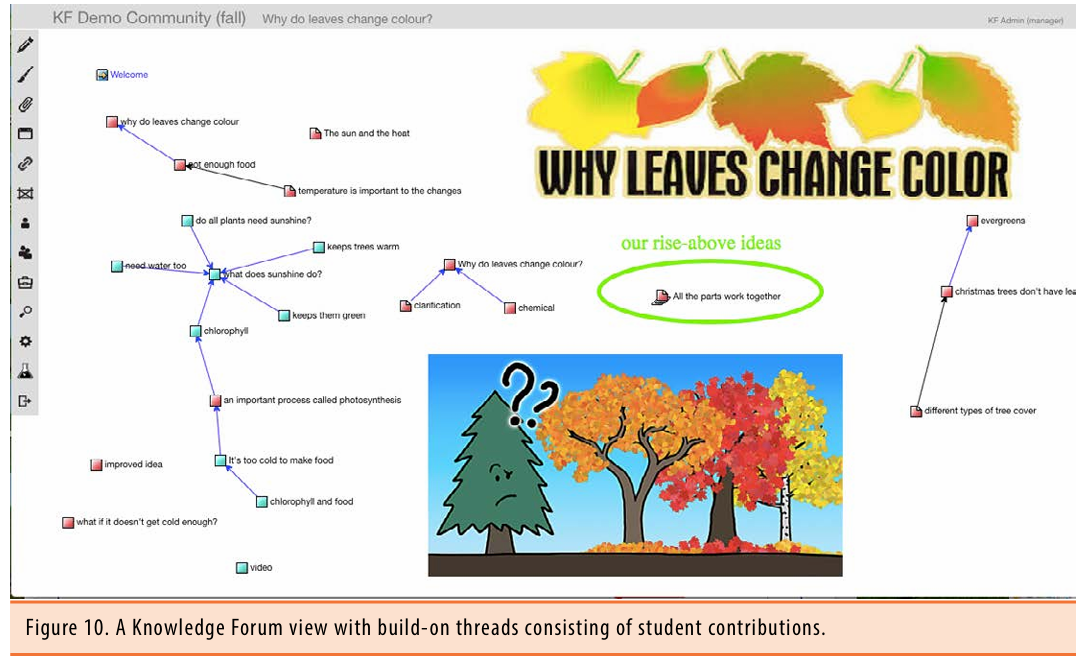
Figure 10 Students’ contributions can be organized thematically within views, which are the spaces in which discussion occurs. Views allow for multiple dialogues to take place within the KF community at the same time, and help to give organization to community knowledge (see Figures 11 and 12). Images and drawings can be uploaded onto the background of views, so that students can take charge of their own discussion spaces by re-arranging notes and customizing their views to help organize and express their ideas.
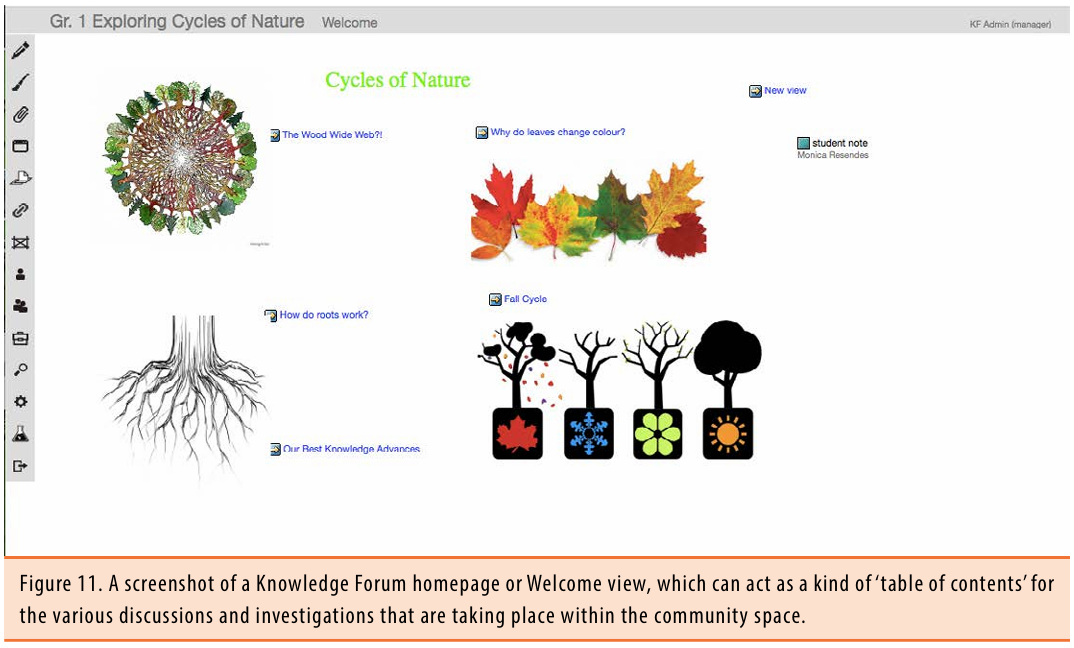
Figure 11 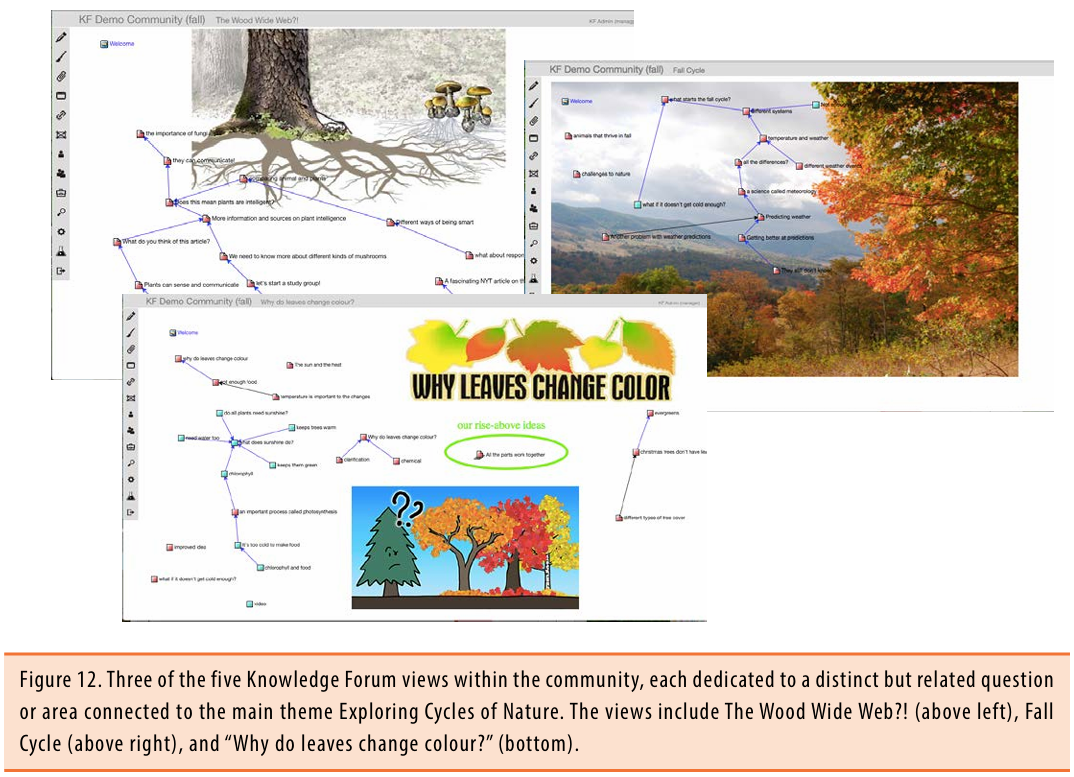
Figure 12 While it is certainly possible to do Knowledge Building without using Knowledge Forum, the technology offers invaluable support and enhancement to the idea improvement process by giving community ideas an infinite space to live and grow, and by offering powerful new ways to assess students’ discourse through the use of automated tools and assessments. As an open and ever-evolving space, it supports assessment-for-learning by giving teachers an opportunity to trace students’ ideas over time and a chance to see where student research is heading.
Wikis’ potential for collaborative knowledge building
As we agree with Scardamalia and Bereiter (2003) who emphasize the importance of knowledge-creating competencies “in a knowledge society”(Scardamalia 2002, p. 67), we wish to point out the necessity of systematically analyzing the potential of wikis as tools for knowledge building. Wikis are web sites which allow users not only to have access to its content but also to change the content online (Leuf and Cunningham 2001; Raitman et al. 2005). Wikis are not only available in the WWW but can also be implemented in intranets or on local computers. Wikis do not require software, are easily accessible, and are simple to use for everybody (Désilets et al. 2005). These qualities make wikis valuable tools for a multitude of purposes (Joyce 2005). Wikis are used for knowledge-management (FuchsKittowski and Köhler 2005; Wagner 2006; Wagner and Bolloju 2005) as well as for educational purposes (Bruns and Humphreys 2005; Chong and Yamamoto 2006; Notari 2006; Wang and Turner 2005); in economical (Wagner and Majchrzak 2007) or in political contexts (Makice 2006). Wikis are mostly used to develop written text. Their special feature is that people can do all kinds of revision of the text: they can create hyperlinks and fill them with content, they can revise a text by adding, deleting, or changing any parts they want to (Raitman et al. 2005). In this way, large groups of like-minded people are able to work collaboratively on one and the same text about a certain topic. In wikis, all users jointly create one hypertext, an activity which allows the collaborative generation of knowledge (Fuchs-Kittowski and Köhler 2005; Köhler and Fuchs-Kittowski 2005). Wikis' potential for collaborative learning lies in their ability to allow for debate-based learning experiences (Chong and Yamamoto 2006) or to facilitate shaping of knowledge (Reinhold 2006). Wikis can be regarded as media which support learning due to their ability to facilitate collaboration (Kim et al. 2006; Notari 2006), to allow for design-based learning (Rick and Guzdial 2006), to enhance inventiveness (Guzdial et al. 2001), and to support inquiry learning and the co-construction of knowledge (Yukawa 2006). Overall, wikis can be considered to support social constructivist learning in general (Bruns and Humphreys 2005).Knowledge Space Visualizer (KSV)
The Knowledge Space Visualizer (KSV; Fujita & Teplovs, 2009; Teplovs, 2010) is a Java based tool that was developed to visualize networks of Knowledge Forum notes. It uses visual representations as well as quantitative network metrics to characterize idea-based networks. Exhaustive similarity measures between notes are recorded as latent semantic links between notes. These links, and the explicit semantic links afforded through referencing, rising-above and building-on functionality of Knowledge Forum, are then made available to the KSV. The KSV is capable of recreating the two dimensional representation of collections of notes in Knowledge Forum, but it also provides computer assisted positioning algorithms to facilitate the visualization of networks of notes.Knowledge Building Discourse Explorer (KBDeX): an application of social network analysis (SNA) for knowledge building discourse
The network structure analysis revealed remarkable differences between knowledge building and knowledge sharing groups. First, the knowledge building group was engaged in collective knowledge advancement in a quite stable manner across the three phases, suggesting their continuous involvement in collective knowledge advancement. Second, contributions by students in the knowledge building group were divergent across the phases. Different individuals contributed in different ways at different phases, which suggests that the organization of inquiries might be distributed across individuals and its structure made them contribute to their knowledge advancement in unique ways. KBDeX can support several parts of these analysis procedures effectively.-
CSCL and its technical support
In CSCL environments, understanding technological affordances is essential, as collaborative learning involves intricate dynamics and technology plays a unique role in facilitating these interactions (Suthers, 2006). Grasping these affordances is crucial for leveraging technology to create effective collaborative learning experiences. While technology offers many affordances, few are easily noticeable and practical (Jeong & Hmelo-Silver, 2016). Building on this understanding, Jeong and Hmelo-Silver (2016) proposed seven core affordances of CSCL, delineating opportunities for learners to (1) engage in a joint task, (2) communicate, (3) share resources, (4) engage in productive collaborative learning processes, (5) engage in co-construction, (6) monitor and regulate collaborative learning, and (7) find and build groups and communities. This is crucial for our study as it provides a foundational framework for understanding CSCL technologies, addressing the specific functional needs and challenges faced by learners and instructors in collaborative settings. Each affordance is unpacked into various dimensions with different technological solutions, emphasizing the complexity and adaptability required for effective CSCL environments. It underscores the necessity of integrating both technological and pedagogical strategies to meet the demands of collaborative learning environments effectively.
Immersive technologies
Immersive technology, encompassing VR, AR, MR, and XR (Handa et al., 2012), blurs the boundaries among physical, virtual, and simulated worlds. This paper narrows its focus to AR and VR due to their pronounced impact on sensory and dynamic multimodal interactive experiences. AR overlays digital information onto the real world, enhancing users' senses (Azuma, 1997), while VR generates interactive virtual environments simulating real-life experiences (Lee et al., 2013). Immersive VR, such as head-mounted displays (HMDs), provides a high level of immersion by blocking out physical cues, unlike non-immersive VR displayed on traditional interfaces (Suh & Prophet, 2018). Immersion is a critical factor considered in this study, acknowledged in various dimensions, including an objective measure of a system’s vividness (Cummings & Bailenson, 2016) and the subjective feeling of participating in a realistic virtual experience (Dede, 2009). Additionally, Xu et al. (2021) introduced the concept of embodied immersion, integrating a sense of immersion, presence, and agency into three major dimensions: physical, sensory, and cognitive immersion. Consequently, this paper delves into the literature on immersive VR and AR technologies, emphasizing their significance in fostering immersive experiences.
Immersive technologies have gained attention in educational research for their potential to promote learning and enrich learning environments by allowing users to interact with the content (Bricken, 1991). They offer interactive visualizations supporting group projects, field trips, and many more. Immersive technologies have been gradually introduced as potential tools for learning and teaching in collaborative learning. Particularly, these technologies offer co-located or remote users a range of advantages, including authentic problem-solving scenarios (e.g., Planey et al., 2023a, 2023b), lifelike 3D representations of figures and objects (e.g., Drey et al., 2022), haptic feedback (e.g., Webb et al., 2022), embodied interactions (e.g., Kang et al., 2021), social interactions and communication (e.g., Yeh et al., 2018), and more. They have been applied successfully in diverse fields such as planetary science (e.g., Brenner et al., 2021), holiday plans (e.g., Geszten et al., 2018), and language learning (e.g., Lin et al., 2023; Perry, 2021).
Collaborative learning analytics (CLA) tools
Learning analytics is commonly defined as “the measurement, collection, analysis and reporting of data about learners and their contexts, for purposes of understanding and optimising learning and the environments in which it occurs’’ (Philip et al., 2011). The primary purpose of learning analytics is to support students’ agency and development of higher-order skills and therefore enhance students’ learning (Chen et al., 2016; Tsai et al., 2020). Aligning with this purpose, a suite of analytical tools that are grounded in KB pedagogical theory and practices have been developed in the KB field. These analytics tools that are integrated in KF include the previously developed Analytic Toolkit (ATK) using log data (Burtis, 1998) and the applets on vocabulary and social network analysis (SNA) developed later. These tools generate sociograms that visualize reading and build-on activities and calculate the corresponding network densities (Teplovs, 2010). Zhang et al. (2009) used network density for reading to measure awareness of contribution of peers and used network density for build-on or reference networks to measure connectedness to peers.
To support the collaborative knowledge construction (CKC) process in higher education, CLA tools are designed to demonstrate students' interaction and participation, knowledge construction, and regulation at the group level, with a particular focus on its social and collaborative characteristics (Wise et al., 2021). Widely-used thinking maps have been utilized as working spaces for students' collaborative knowledge construction in higher education, namely mind maps (e.g., visual, non-linear illustrations of ideas and their relationships), concept maps (e.g., connections between relevant concepts, like “lead to” and “result from”), and argument maps (e.g., argumentative structures with nodes symbolizing claims and evidence and links representing relationships like “for” and “against”) (Bodemer & Dehler, 2011; Davies, 2011; Hoffmann, 2015). In addition, CLA tools, such as the knowledge awareness tool, have been applied to track and analyze students' knowledge acquisition and development, with the goal of providing insights on students' knowledge states, fostering student achievement, and supporting instructional practices (Jyothi et al., 2012; Marzano & Miranda, 2021). Text mining and natural language processing techniques have been implemented in CLA tools to demonstrate the connection between keywords, the distribution of discourses, and the relatedness between peers' perspectives (Allen et al., 2022; McNamara et al., 2017; Suthers et al., 2010). However, these CLA tools lack the presentation of comparative perspectives between students and the sharing and negotiation process of perspectives proposed by students during peer interaction, which is essential to reflect the process-based development of collective knowledge during CKC processes in higher education. Considering the CKC nature, it is beneficial to present comprehensive feedback on the CKC process that can diagnose characteristic, change, and development of students' perspectives, including the quantitative frequencies, sequences, and connections of views (Wise et al., 2021).
AI & Agent
The concept of Hybrid Intelligence entails an ideal combination of human with artificial intelligence. This enables a scenario of computer-supported collaborative learning (CSCL), in which multiple learners, the “human agents” construct knowledge together through negotiation, argumentation, and mutual regulation among learners. Decades of research in CSCL have demonstrated that collaboration, when properly supported, leads to higher-order learning outcomes such as critical thinking, metacognition, and knowledge integration.
To enable these processes, CSCL traditionally relies on instructional scaffolds, such as collaboration scripts and group awareness tools, which provide structure and guidance for effective interaction. Collaboration scripts define roles, phases, or prompts that help learners coordinate tasks, reason together, and engage in transactive discourse (Fischer et al., 2013; Kollar et al., 2018). Group awareness tools, on the other hand, visualize aspects of the group process, such as participation or knowledge contributions, to support regulation and coordination (Bodemer & Dehler, 2011; Janssen & Bodemer, 2013).
While these supports have proven highly effective, the key challenge for contemporary CSCL lies in adapting support dynamically, matching the level of guidance to learners’ needs and stages of collaboration.
In this regard, AI-driven conversational agents introduce a new paradigm by dynamically responding to learners’ discourse through natural language processing and machine learning. They can deepen the dialogue by prompting elaboration or broaden it by introducing new perspectives. Our recent empirical findings show that while deepening agents promote cognitive elaboration and broadening agents expand conceptual coverage, too much agent intervention can reduce engagement, pointing towards the need for balance between guidance and autonomy.
-
小组讨论:知识论坛 vs 通用协作工具
活动类型:讨论交流活动名称:小组讨论:知识论坛 vs 通用协作工具活动描述:使用智能体协助,从“支持观点改进”、“促进社区知识发展”、“嵌入形成性评价”等维度,对比分析知识论坛与一款通用的在线协作文档工具(如腾讯文档、Notion) 在支持知识建构上的异同与优劣。-
小组讨论活动说明
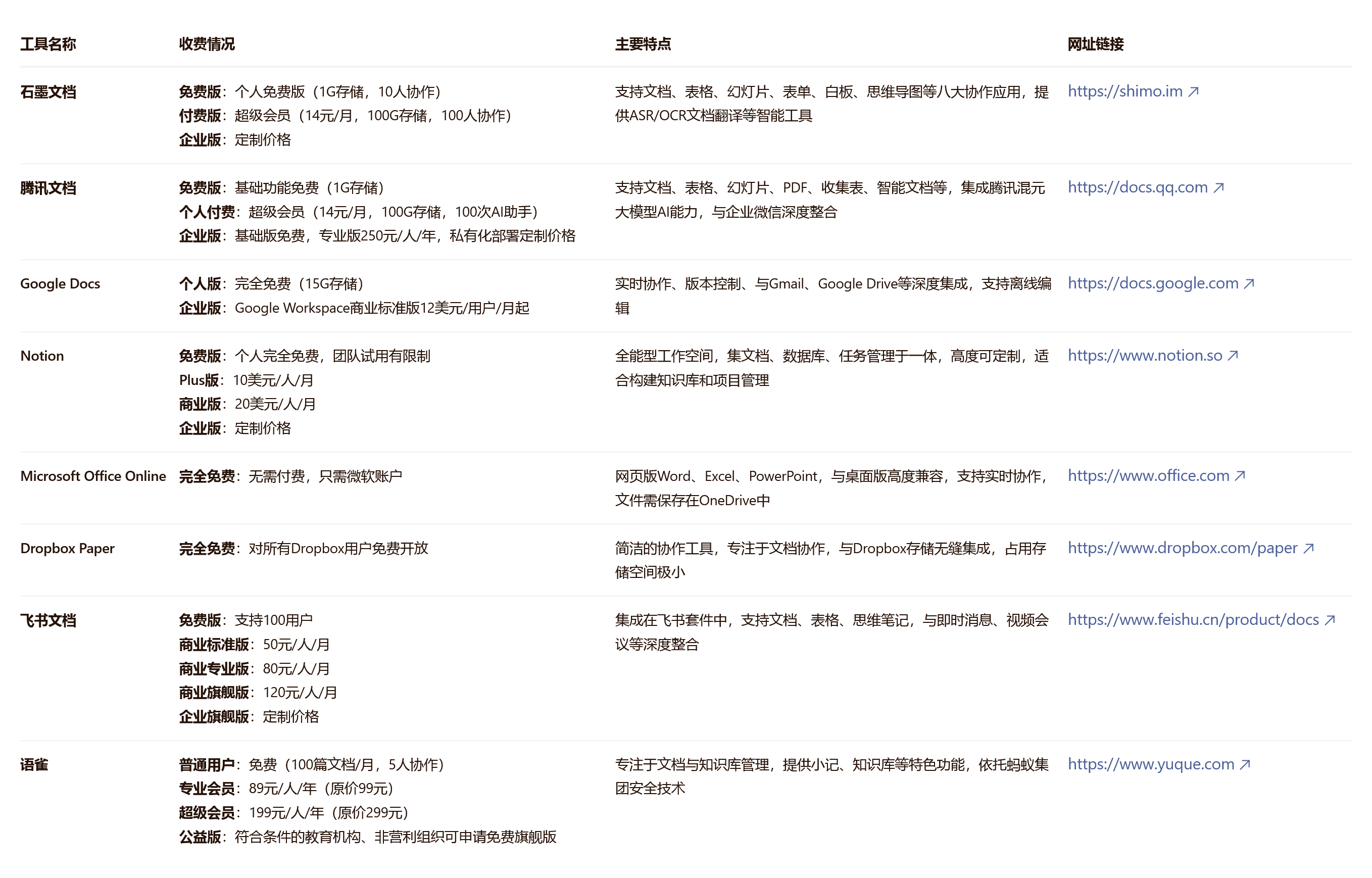
在线协作文档工具(常见的8款)【点击即可查看】
思路引导:结合前期使用“知识论坛”或“通用协作工具”的协作学习经验,填写第四讲 小组深度讨论引导单,先通过用户移情图回顾使用体验,再通过反馈捕捉矩阵系统梳理对“知识论坛”(如Knowledge Forum)与“通用协作工具”(如腾讯文档、飞书、Notion等)在知识建构方面优劣的思考,最后,提炼小组观点,形成结论。
参考文献:学习管理系统和社交平台协作学习知识建构层次分析_柳瑞雪
Tips:在使用反馈捕捉矩阵系统梳理二者在协作知识建构方面的优劣时,可通过智能体(https://www.coze.cn/s/E7-IUPuAgiA/)查阅相关文献加以分析。【例如,请帮忙查找有关“知识建构”的相关文章,分析······(XX工具的使用体验)在知识建构方面的优劣。】
提示词指南(仅供参考,不限于此):第四讲 小组讨论交流活动的提示词指南
-
元宇宙教学案例
案例背景:复旦大学元宇宙平台以最初建设的《电离辐射探测与测量虚拟仿真实验》为技术基础,结合复旦大学众多院系的应用场景,共同打造集各院系不同专业内容于一体的元宇宙平台,包括哲学学院、心理系等多个国际知名专业方向。
-
小组作品策展:设计我心目中的在线学习环境
活动类型:作业提交活动名称:小组作品策展:设计我心目中的在线学习环境活动描述:作品:1.体现未来学习环境的理念。 2.可设计未来校园,或未来教室等。 3.考虑技术与教育的融合创新。 4.考虑多维交互以促进深度学习。 5.上述设计试图回答在线学习环境设计的哪些焦点问题? 提交模板 见活动说明。-
课后作业:小组作品策展活动说明(第18周周一截止)
***提交模板:【模板】利用元宇宙平台设计“在线学习环境或学习空间”作品解说文档
相关案例:魔珐有言AI制作数字人视频案例 制作指南:魔珐有言AI使用教程
元宇宙体验区:Inphi元宇宙体验 https://www.inphi.online/ 或 Virbela元宇宙平台 https://www.virbela.com/download
相关视频:元宇宙平台Virbela操作指南
相关指南:VirBELA Open Campus Onboarding Quick User Guide 1 Quick User Guide 2 Virbela Go User Guide
(更新,课后作业)小组作品策展活动:利用Delightex Edu平台,小组协作制作的“在线学习环境/学习空间”数字作品。
(1)思路引导:1.在第一节课已提交数字作品的部分小组,可将其作为最终作品的初步设想,并在此基础上,尝试用Delightex Edu平台实现这些设想,或设计新的作品。2.最终的作品形式,可采用视频录制结合PPT/word文档的方式(但不限于此)呈现数字作品。3.提交的作品建议图文并茂,重点描述:当前在线学习环境存在哪些问题?本作品从哪些方面开展设计以解决这些问题?本作品还存在哪些局限性?未来的优化目标有哪些?【问题与解决方法可结合相关文献论述,例如:“设计了XXX,提升了教学存在感/社会存在感/认知存在感”】。
(2)提交格式:视频讲解(数字人视频或普通讲解的视频录制均可,但不限于此)+文本说明(PPT或word格式均可,但不限于此)(命名:“视频讲解,第X组-组长-组员”;“文本说明,第X组-组长-组员”),重点介绍“在线学习环境/学习空间”数字作品的设计特点、能够解决传统在线学习环境/学习空间的那些问题、本作品还存在的局限性、未来的优化目标,以及过程中智能体和其他相关AI工具的使用情况(例如,截图、设计说明等)。
(3)提交时间:第18周(2026.06.29当晚24点整截止)提交,在此期间,各小组均可在Delightex Edu平台设计与完善“在线学习环境/学习空间”。(该活动纳入平时成绩)
元宇宙体验平台:Delightex Edu平台【先注册,可选择简体中文界面】
Delightex Edu平台的注册教程、操作指南及相关案例:
1.注册与登陆教程:Delightex-getting-started-kit-2_5(英文版) Delightex-getting-started-kit-2_5(中文版)
PS:1.注册过程中的“班级邀请码(class code):RZ62M”。2.注册后,点击平台页面中的“权限许可”的“升级版(试用)”;然后在“合成”中,可开启“AI Buddy”“谷歌课堂”“网页搜索”“3D对象搜索”,便于设计学习环境时直接使用AI等辅助工具。
2.学生手册:Student handbook(英文版) Student handbook(中文版)
3.学习环境设计案例:设计您的学习环境 课程计划(英文版) 设计您的学习环境 课程计划(中文版)
用增强现实(AR)展示你的教室 课程计划(英文版) 用增强现实(AR)展示你的教室 课程计划(中文版)
4.AI人物设计:AI Buddy 文化课堂:在 3D 环境中打造一位负责任的语言辅导老师 课程计划(英文版)
AI Buddy 文化课堂:在 3D 环境中打造一位负责任的语言辅导老师 课程计划(中文版)
5.编程模块介绍:编程卡片(英文版)【PS:有图形化编程基础的同学,可尝试融入编程,设计动画】
PS:可基于自身与小组对未来学习环境的思考与想法,通过智能体(https://www.coze.cn/s/E7-IUPuAgiA/)对话,查找相关文献或案例,以启发思考。
例如:“请检索有关‘XX(元宇宙)’的国内外文献,谈谈如何利用元宇宙创设师范生教学实训教室?”
或:“请提供利用元宇宙或VR、AR等相关技术设计智慧教室或智慧学习环境/学习空间的案例。”
-
评阅小组作品
活动类型:社会化批阅活动名称:评阅小组作品活动描述:每个同学至少评价2个作品,且不能评价自己组。 评价依据: 1.作品是否体现了未来学习环境的理念;2.作品是否逻辑结构清晰严谨,内容是否完整详细;3.作品是否回答了在线学习环境设计的哪些焦点问题,是否具有创新性-
个体学习反思
活动类型:作业提交活动名称:个体学习反思活动描述:1.上传第一讲、第二讲、第三讲、第四讲你与智能体/AI工具对话的长图(确保图片清晰可见),或网址链接(确保能打开),或word文档都可以。 2.结合学习反思单,反思对智能体/AI工具的使用。-
课后作业:学习反思活动说明(20260605截止)
4F反馈法是一种非常经典的反思模型,分别代表:Facts(事实)、Feelings (感受)、Findings (发现)和Future (未来/下一步)。这种方法可以帮助你从单纯使用智能体和其他AI工具的学习经历回顾,走向深度的批判性思考和行为改进。
***个体与群体反思活动纳入平时成绩。【1.不以智能体使用能力/AI使用能力作为评分依据。2.重点考察提交的文档或长图的时间,与课程使用“智能体及其他AI工具”的时间对应(即:真实性、完整性和清晰度)。3.使用的智能体及AI工具类型及数量不做限制。】
提交截止时间:2026年6月5日
PS:针对你“与智能体及其他AI工具对话”,以及过去四讲学习中的“人机协作”的任务要求,填写第四讲 学习反思单,反思4个问题(但不限于此,如果有其他反思也可填写在反思单中提交)。
注:过去四讲学习中的“你与智能体及其他AI工具对话”,可提交导出的“word文档格式”(图片如果太长,可提交导出的word文档),或“长图”(图片保持清晰,提交前检查清晰度),或“网址链接”(确保能够打开网址),并附在“学习反思单”的最后。
何雨轩同学的个体学习反思中,有提到“推荐使用软件verycapture,可以长截图,很好用!”(有需要的同学可参考,但不限于此)
-
群体学习反思:共同讨论人机协作经验,促进人机协作能力
活动类型:讨论交流活动描述:围绕你上传的 第一讲至第四讲 你/他人与智能体/AI工具对话的长图,以及你/他人的个体学习反思开展讨论交流,并反思与回应以下问题: 1.我认为某位同学在人机协作(如内容理解、创意生成、PPT设计等)方面做得好?为什么? 2.从某同学的反思中,我发现了自身的哪些不足?学到了什么?-
拓展阅读 & 作品策展
1.知识建构的相关文献:知识建构引领教育创新_理论、实践与挑战——访国际知名学习科学专家波瑞特教授和斯卡德玛利亚教授_柴少明
从浅层建构走向深层建构——知识建构理论的发展及其在中国的应用分析_张义兵
知识建构的12条原则 知识建构:理论、教学法与技术 知识建构与知识创造:理论、教学法与技术
2.知识建构的相关平台:知识建构及知识创造共享
3.学习环境/学习空间的相关文献:基础教育智慧学习空间建设的SWOT透视——以南京市江宁区为例_景玉慧
国外学习空间研究述评_杨俊锋 面向人工智能时代的学习空间变革研究_许亚锋 涌现的学习活动——ACAD学习空间设计框架评介_仇晓春
国内外学习空间的再设计与案例分析_江丰光 基于目标导向“教学法—空间—技术”(PST)框架的学习空间再设计及其案例研究_华子荀
校园场所感的技术促进策略设计与案例研究——以“徜徉校园”工具为例_陈佳雯 学习空间相关案例
4.第三讲概念图作品策展:(1)“典范”组:第二组 何雨轩 朱琪琪 李金香 张笑菡SWU张笑菡 第五组 张新悦 杨馥蔚 刘永青 黄子涵swu张新悦
(2)“精进”组:第六组SWU王晓 第七组 钟林容 许邯郸 邹何林SWU钟林容 第一组 陈佳凝 郭韫 骆开燕 张晨SWU陈佳凝
-
提问答疑
活动类型:提问答疑活动名称:提问答疑活动描述:同学们好!欢迎学习第四讲。请大家将文献研读和活动参与中遇到的疑问,发布在提问答疑区。 无论是概念理解还是案例分析,都可以畅所欲言。也可提问前几讲的相关问题。 助教会在这里实时跟进,为大家即时解答。也鼓励大家相互解答,共同攻克难点! PS:可匿名提问,但必须围绕课程或活动内容! -
-
- 标签:
-
加入的知识群:
.jpg)

学习元评论 (0条)
聪明如你,不妨在这 发表你的看法与心得 ~